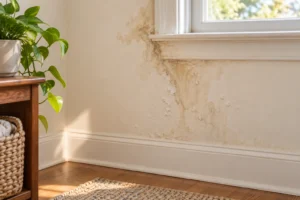
Locate both the recurring growth and the water pattern. A room-facing sill with repeated condensation, a frame that becomes wet during rain, and a soft wall below the window need different investigations. Cleaning the same visible area will not establish why moisture returns.
Assess the task before cleaning
Keep away from damaged glass, unstable framing, wet electrical fittings and unsafe high-level access. Do not lean through the opening or remove trim to investigate. Extensive, concealed, contaminated-water or damaged-material concerns need an experienced professional, and health concerns should be discussed with a health professional before cleanup.
EPA’s home-cleanup guidance explains that cleanup scope depends on more than size, including water damage, contaminated water and HVAC concerns. It describes suitable hard-surface cleaning and complete drying, while porous affected materials can need replacement. Its protective-equipment guidance should be read before a suitable owner task; a small visible area does not prove that hidden material is unaffected.
Make the window’s water pattern the main question
| Pattern already observed | Useful next step |
|---|---|
| Room-side glass and sill repeatedly collect droplets. | Use the condensation guide to identify the wet surface and room-moisture pattern. |
| One frame or adjoining wall becomes wet after rain. | Give the installer the weather timing and first visible water location; source tracing differs from room-moisture control. |
| Wood, finish or wall remains soft/damaged after the glass dries. | Ask for a material/hidden-extent assessment, not just glass cleaning. |
Andersen’s interior-condensation guidance explains the room-side moisture mechanism. That does not establish that every wet frame is caused by condensation or that its particular window construction matches yours.
Keep the window operating/drainage instructions with the repair plan. Do not block drainage slots or required ventilation, remove trim to explore, or use a cleaner suited to glass on an unidentified coating or joint. For the separate cleanup scope, use the EPA guidance below and the bounded surface-cleanup explanation; this page’s purpose is finding why the window area keeps getting wet.
If condensation repeatedly wets the indoor sill
Record the wet surface and timing, room use and extraction behavior. Note whether adjacent windows are also affected. Use the window condensation guide to distinguish room-facing droplets from exterior dew and between-pane haze. These observations prevent treating every misted window as the same defect.
Control appropriate room moisture sources and use installed ventilation as intended. A humidity log can support the investigation, but one reading cannot identify the source or confirm a safe room. Do not permanently seal an opening or block required ventilation to stop the visible symptom.
Wipe ordinary accessible condensation according to the window’s care instructions, when doing so is a safe task and does not disturb suspect material. Repeated wiping may limit immediate wetness but is not the correction for persistent moisture. Record whether the sill actually dries between events.
If rain wets one frame or the wall beneath it
Record the weather and first visible water location without deliberately spraying the window. Water can travel through a joint or construction detail before it becomes visible. An installer or suitable building professional should trace the source and assess affected material.
Do not caulk every gap, block drainage holes, remove exterior trim or assume that a bead around the indoor stain repairs the route. Use the damp-wall guide for the investigation record. Rain leakage and indoor condensation can coexist.
If a seal, finish or frame is deteriorating
Report separating seals, peeling paint, swelling, softness or an area that remains wet after nearby glass dries. The window’s construction matters: a cleaning method safe for glass may damage wood, coated metal, sealant or another finish. Do not scrub a degraded joint or sand unknown older paint as part of mold cleanup.
Ask whether the affected part is a cleanable surface, a damaged finish, deteriorated porous material or a concealed assembly. Surface cleaning is not necessarily the complete scope. Do not paint or apply new sealant over growth; moisture control and appropriate material recovery should precede refinishing.
For a suitable small surface-cleanup task
Follow the EPA guidance and the surface manufacturer’s instructions, including exposure precautions and appropriate protection. Use a compatible cleaning method without generating airborne debris, and dry the area completely. Do not mix products, use an improvised chemical recipe, or spray cleaners into frame cavities.
Stop if material breaks up, the area extends behind trim, or cleanup cannot be done without unsafe access. The appropriate contractor should assess hidden extent and moisture rather than simply offer a stronger spray. Color or a stain alone cannot identify a mold species or its health significance.
Check the outcome through the original trigger
Keep the photographs, water-pattern log, cleanup scope and repair findings. After correction, compare through the weather or room-use conditions that previously produced wetness. Check that normal window operation and drainage remain intact.
If growth or odor returns, report when and where it reappears for reassessment. Ask the provider to show how the moisture source, material condition and cleanup were addressed. A clear-looking sill immediately after cleaning does not establish that a recurring problem was resolved.