A weak stream is a low-flow observation, not a pressure measurement. First establish whether the change affects one outlet, one temperature supply, the whole home or only periods of simultaneous use. That pattern helps separate a local fixture restriction from a supply or pumping problem.
Check whether there is a supply incident or active leak
For a sudden whole-home change, check current notices from your water supplier or building manager. Ask whether nearby homes or units are affected. Follow any water-quality or interruption instructions from the responsible supplier; clear-looking water does not cancel an advisory.
If you can see a significant leak, stop using the affected equipment and obtain plumbing help. Use a familiar accessible shutoff only if it operates safely without force. Do not approach wet electrical controls, pump wiring or flooded equipment. A suspected concealed leak with sudden low flow also needs assessment rather than an arbitrary pressure adjustment.
Use the pattern to choose the right investigation
| Observation | What to investigate next | What it does not establish |
|---|---|---|
| One outlet is weak; nearby outlets behave normally. | That fixture’s approved screen, aerator or spray-head maintenance. | That incoming pressure is low throughout the home. |
| Hot flow is weak at several outlets but cold is normal. | The shared hot-water supply path, with a plumber. | A failed heating element: flow and temperature are different symptoms. |
| Both supplies are weak throughout the home. | Supplier incidents, neighbouring properties and the property’s shared supply equipment. | Whether a restriction or supply fault lies before or after the property connection. |
| Flow falls mainly when another fixture operates. | Which combination causes the change and whether it is new. | That increasing a pump or regulator setting is an appropriate repair. |
A useful report is specific: “Kitchen cold and bathroom cold both became weaker this morning; the shower also changes when the kitchen tap runs.” This is an illustrative description, not a customer case or a diagnosis. It is more informative than “the pressure is bad” because it identifies the affected supply and use conditions.
Unitywater’s utility guidance supports checking supply incidents, neighbouring properties, fixture patterns, leaks and time of occurrence. It is Australian guidance: its local pressure figures, infrastructure assumptions and valve instructions are not Saint Lucia requirements. Follow your own supplier’s instructions. The Moen reference below applies to its faucet examples, not the entire water network.
Compare outlets one at a time
In an otherwise safe system, briefly compare normal flow at nearby fixtures separately. Note whether hot, cold or both have changed and whether opening another fixture makes the symptom much worse. Do not run every tap together and then interpret that loaded condition as the normal supply pressure.
Record the fixture, time, temperature selection and recent plumbing work. For water supplied through a tank or pump, include any ordinary controller indication and whether the storage supply appears available without opening equipment or climbing to a tank. Do not reset a pump repeatedly or bypass a dry-run or other safety protection.
Turn a timed flow observation into a useful number
If your supplier permits a simple timed-volume check, use an ordinary accessible cold-water tap, a small marked container and a timer, without disconnecting fittings or altering controls. Keep the area dry, collect only what you can handle easily and stop for leaks or unsafe conditions. Follow your supplier’s method; a comparison is optional, not a reason to run every tap or approach a pump.
Litres per minute = litres collected × 60 ÷ seconds. For US gallons, the same formula gives US gallons per minute when the collected volume is measured in US gallons. Keep units consistent.
| Record | Collected | Elapsed | Calculated flow |
|---|---|---|---|
| Earlier | 2 litres | 10 seconds | 12 L/min |
| Later | 2 litres | 20 seconds | 6 L/min |
The later flow is half the earlier flow. It does not mean pressure halved: no pressure was measured. A different tap, valve position, aerator, simultaneous demand or supply condition can invalidate a simple before/after comparison.
Unitywater uses a timed bucket check within its own service process. Its threshold and minimum pressure apply locally; they are not universal pass/fail limits. Send the measured volume, time, outlet and conditions to your own supplier or plumber, who can decide whether pressure measurements or a restriction investigation are needed.
If only one fixture has low flow
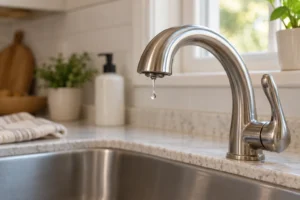
Find its model and maintenance instructions. An accessible aerator, screen or spray head may be restricted, but the removal method differs between exposed, recessed and pull-out designs. Use the correct tool and approved cleaning method where this is a suitable owner task; do not damage an aerator with pliers or discard a flow-control component.
Moen’s kitchen-faucet guidance distinguishes faucet and spray arrangements and temperature-specific symptoms. It illustrates why a model-specific check is better than replacing every cartridge after noticing a weak stream. If approved cleaning does not help, give the manufacturer or plumber the observed pattern.
If only hot or only cold is affected
Compare that same temperature at another fixture. One affected faucet points toward a different scope from reduced hot flow throughout the home. Report recent supply-valve work, a heater replacement or other change. A valve or supply restriction may need investigation before changing fixture parts.
Do not open a live hose, dismantle a mixing valve or force old shutoffs to test the theory. For reduced hot-water temperature rather than reduced flow, use the water-heating performance guide. These are different symptoms and should be described separately.
If several fixtures are affected
Give the supplier or plumber the whole-home pattern and whether it is continuous or only occurs during high demand. Relevant checks may include incoming supply, pressure regulation, filters, leaks or a private pump/storage system. The appropriate scope depends on the actual installation.
Ask for measured conditions where pressure is part of the diagnosis, including whether readings are taken at rest or during use. Do not adjust a pressure regulator, pump switch or relief device using a generic target from an online article. Local requirements and the system’s rated limits matter.
If it began after maintenance or an interruption
Record what was changed and whether valves or filters were serviced. Let the installer verify restored valve positions, filter requirements and possible debris restrictions. Do not remove treatment or backflow devices to increase flow, or assume every fitting should be turned fully in the same direction.
If discolored water or a supplier advisory accompanies the change, follow the supplier’s instructions before cleaning or flushing fixtures. A repair should address the source of the changed performance without compromising water-quality protection.
Verify the improvement under comparable use
Compare the same fixtures individually and under the ordinary combination that previously caused trouble. Keep any professional pressure readings and the repair record. Check accessible serviced connections for new leakage.
If the symptom returns, report whether it is still local, temperature-specific or whole-home. That evidence helps the next investigation stay focused and avoids repeatedly replacing faucet parts when the restriction lies elsewhere.