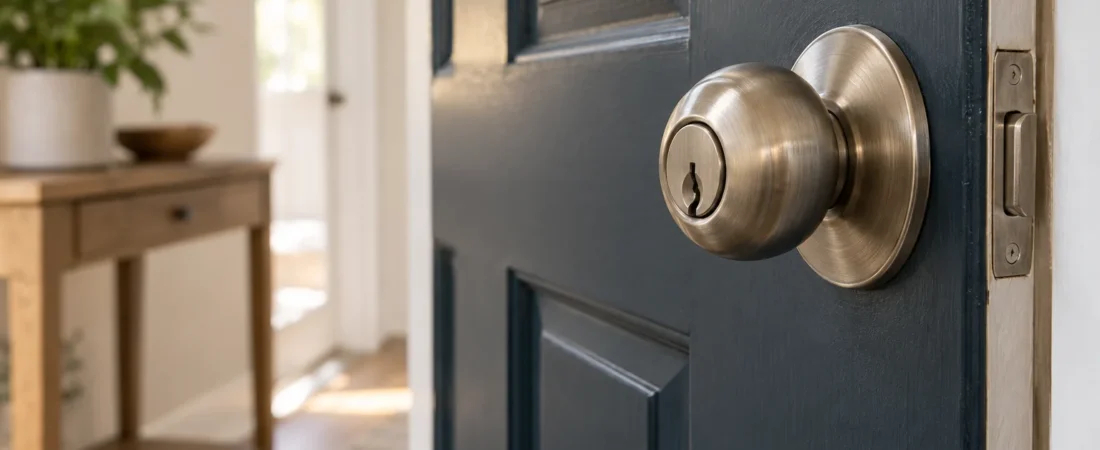
Separate resistance in the key or lock from resistance caused by the door’s fit. Note whether the key is difficult to insert, the cylinder resists turning, the handle will not return, or the bolt binds only when the door is closed. These observations give a locksmith more useful information than a general report that the lock is stiff.
Stop before the key or exit becomes unreliable
Do not force a stuck key, use pliers to turn it, or bend it back into shape. Stop if the key begins to twist or the mechanism jams. If the door cannot secure normally, arrange prompt locksmith help. If people cannot leave reliably, treat that as an urgent access problem. Do not wedge shut or add a makeshift barrier to an escape route.
Do not dismantle safety, fire-door or shared-building hardware from general advice. Report those defects to the responsible manager. This guide concerns an authorized owner’s normal lock operation; it is not a lock-opening or security-bypass procedure.
If the key is hard to insert or remove
Inspect the key visually for a bend, damage, heavy wear or debris. If it is clearly damaged, stop using it. A known correct spare can be compared gently only if the mechanism is not already jammed. Never force an uncertain key, and do not keep making copies of a worn key to resolve the problem.
If one sound key works normally and another resists, give both to the locksmith to evaluate. If every correct key resists, the cylinder or another part of the mechanism may need attention. This comparison narrows the service request without proving which internal component is faulty.
If it binds mainly with the door closed
Only where the door is stable, normal operation is safe and you can avoid locking yourself out, compare the lock’s ordinary operation with the door open and closed. Keep fingers away from the bolt and retract it before closing. Stop at resistance; do not perform this comparison on an exit already jammed or on unfamiliar interlocked hardware.
If normal operation is easy while open but difficult when closed, report an alignment-related pattern. Schlage’s latching guidance explains how bolt and strike alignment and door sag can affect engagement. A locksmith or door installer should assess the fit before removing material or shifting a strike.
Record whether lifting, pushing or pulling the door has previously been necessary. Do not use that force as a permanent way to operate it. For rubbing before the door reaches its frame, see the sticking-door guide; for a latch that fails to engage, see the door-closing guide.
Use the key comparison and door position together
Only use observations from safe, ordinary operation: the door must be stable, the lock must not be jammed, and a reliable exit must remain available. Do not force a key or close an exit that may trap someone. If either condition is uncertain, skip the comparison and arrange a locksmith.
| What was observed | Useful interpretation | What to avoid buying on that evidence alone |
|---|---|---|
| One correct key resists; another sound correct key works normally in the same position. | Have the keys assessed as well as the mechanism. Keep both labelled for the locksmith. | A complete lock because one key is worn or damaged. |
| Correct keys operate normally with the door open, but resistance occurs when closed. | Door fit and the bolt/strike relationship deserve assessment. | Lubricant as a substitute for correcting interference. |
| Correct keys resist in both safe positions. | The symptom is not explained solely by the door being closed. Give the locksmith the mechanism and key history. | An alignment repair presented as a confirmed cure. |
| A key problem and closed-door resistance occur together. | More than one issue may be present; report both instead of choosing one explanation. | A claim that one successful operation rules out every other fault. |
This combines the key observations above with Schlage’s explanation of door/strike interference. It is a service-routing comparison, not an internal lock test. After correction, key operation, full engagement and reliable exit all matter.
If a handle or latch does not return normally
A sticky cylinder is different from a handle that droops or a latch that will not retract. Describe which part moves and what happens during ordinary operation. Schlage’s latch-support guidance identifies fit, loose hardware and wear as possible concerns. Use support instructions for your specific hardware or have a locksmith assess it.
Do not remove a spring, disable a latch, loosen every mounting screw, or slam the door to make it catch. Hardware fit and secure engagement should be preserved through the correction. For a newly installed lock, report the problem to the installer before deciding the mechanism has worn out.
Use maintenance products only with model approval
Consult the lock manufacturer before adding lubricant. Cylinder, latch, hinge and electronic-lock components may have different care requirements. Do not pour household oil, solvent, water or an unfamiliar spray into the keyway. A product suitable for one mechanism is not automatically suitable for another.
For an electronic lock, record the displayed message or low-battery indication and follow its normal user guide. Do not factory-reset it as a general remedy: that can remove authorized settings without correcting a binding bolt. Mechanical resistance still warrants assessment even if the electronics respond.
Verify reliable locking and unlocking
Give the locksmith the hardware brand/model if known, the exact symptom, key comparison, open-versus-closed pattern, recent installation or weather-related change, and any prior force needed. Ask what caused the resistance and whether door fit and full bolt engagement were checked.
After the correction, confirm ordinary locking and unlocking without unusual pressure from the appropriate sides while preserving safe exit. If resistance returns, stop forcing it and report when it recurs. Partial movement of a key or a lock indicator alone does not verify that a misaligned door is securely engaged.