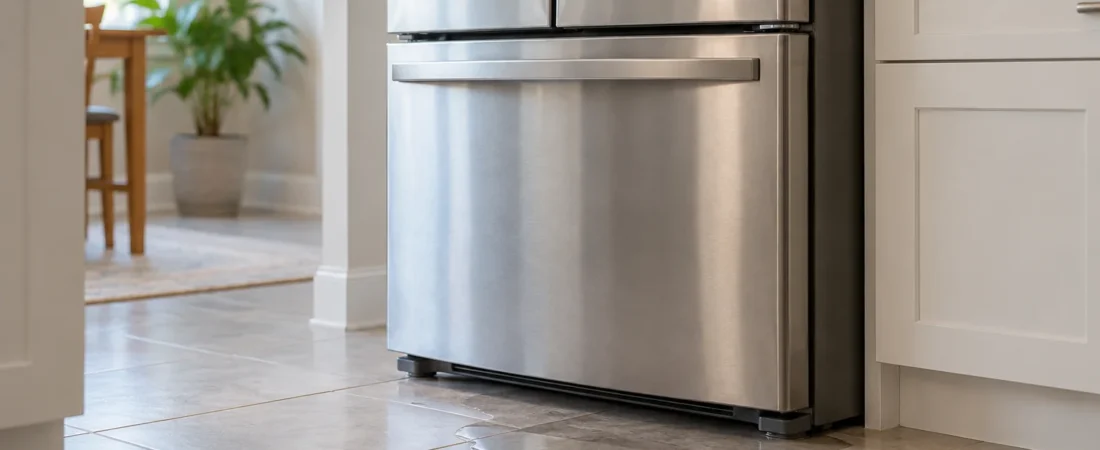
First establish whether water is inside the cabinet, below the door, around the dispenser, or on the floor behind the appliance. A puddle can spread far from its source. Record where it first appeared and whether cooling, ice making, or dispensing changed at the same time.
Protect people and food before investigating
Keep people away from a slippery floor. If water has reached a plug, socket, cord, or electrical component, do not step into it or reach through it to unplug the fridge. Arrange safe electrical isolation and professional help. Do not pull the appliance across a wet floor.
If power must be disconnected or the fridge is also warm, protect perishable food and record the time cooling was lost. Use the refrigerator cooling guide for thermometer-based food-safety steps. Do not leave food warming while carrying out a lengthy leak investigation.
Start with whether the fridge has a water supply
| Configuration or location | Relevant distinction |
|---|---|
| Plumbed ice maker or dispenser. | An external supply and its connections add a leak path, including while cooling power is off. |
| No external water connection. | A supply hose/filter diagnosis may not apply; consider spills and the model’s internal drainage arrangements. |
| Water first appears inside, then below the door. | Whirlpool describes blocked defrost drainage as one possible path, requiring model-specific assessment. |
| Wet dispenser tray after use versus continued dripping. | Record the timing and recent filter work; these are different complaints. |
Whirlpool’s linked guidance distinguishes defrost drainage, water-line and installation/filter issues. A puddle alone does not select between them. Its drain-inspection advice calls for professional assessment; do not use a wire, boiling water or hidden-panel removal based on this table.
For an owner-permitted filter check, first match the appliance model and filter part to its manual, then read the isolation, fitting and post-installation instructions together. A generic filter that physically fits is not evidence of compatibility. Skip access that requires moving the fridge, handling a damaged housing or approaching wet electrics.
If the refrigerator has a water connection
A plumbed ice maker or dispenser adds a supply line, filter, and related connections to the possible sources. If an accessible, clearly identified water shutoff can be operated safely without moving the appliance or touching wet electrical equipment, close it to limit a continuing supply leak. Do not force a seized valve. Seek help if the valve is inaccessible or unidentified.
Record any recent filter replacement, installation, or movement of the fridge. Check only visible, safely accessible areas. Do not disconnect tubing, tighten unfamiliar fittings, or dismantle an internal valve. A water connection may continue leaking even while the refrigerator is switched off.
If water collects inside
Check for a spilled container or package using normal shelf access. Dry a small spill where safe and see whether water returns during ordinary use. Do not assume water beneath a drawer is a spill if it repeatedly reappears.
Whirlpool’s refrigerator leak guidance identifies a blocked defrost drain as one possible reason water collects inside and later reaches the floor. It also identifies installation and filter problems as possible contributors and recommends model-specific instructions and professional assessment of drain blockages. Those possibilities do not diagnose your refrigerator from puddle location alone.
Do not force a wire into an unidentified opening, pour boiling water inside, or remove freezer panels to clear a guessed drain. Drain layouts and access vary. Follow the exact manual only for maintenance explicitly intended for the owner; otherwise ask an appliance technician to inspect the drainage system.
If the dispenser area is wet
Note whether the tray is full, water appears only immediately after dispensing, or dripping continues between uses. Record whether a filter was just changed. Empty and clean a removable drip tray only as the manual permits; a full tray is different from an unexplained continuing leak.
Check the installed filter against the exact model’s approved part and fitting instructions. Stop if checking it would require handling a damaged housing or an uncontrolled leak. Do not substitute a generic filter or bypass part to make the leak stop. Give the model, filter details, and timing to the service provider.
If water is underneath or behind
Keep the puddle’s original position in your notes before cleaning accessible dry-safe areas. Water can come from a supply connection, cabinet drainage, a pan, or another nearby source. A pan may normally contain some defrost water; finding water there is not by itself evidence that it is faulty.
Do not tip, drag, or reach under a heavy fridge to inspect hidden parts. Ask a technician to move it safely and inspect the relevant components. If the appliance was recently installed, tell the installer about the timing and ask whether its position and water connection meet the model instructions.
Check the door without guessing at a repair
Look for food packages obstructing closure, a visibly displaced seal, or damage using ordinary access. Clean the seal only by the method specified in the manual. Do not heat the gasket, adjust hinges, or change the appliance’s tilt from generic advice. Persistent door problems or moisture need model-specific assessment.
Verify the source was corrected
Give the technician the model, water-connection status, first wet location, timing, recent changes, and cooling symptoms. Ask which source was confirmed and what was repaired. Monitor the affected area during ordinary use after service and dry accessible wet surfaces safely. A dry floor once does not prove that an intermittent leak is resolved.
If flooring has swollen or lifted, record the affected area and seek assessment of the material and moisture below it. Fixing the fridge leak does not automatically dry a concealed floor. See the buckled-floor guide for separate warning signs and next steps.


