A room that stays warmer than neighboring rooms can have a local airflow, solar-gain, or building-envelope problem even when the cooling equipment works. The most useful evidence is a consistent pattern: time of day, door position, airflow, and how the room compares with the rest of the home. Start with observations before changing equipment or cutting new vents.
Compare two rooms without changing several variables
| Time/conditions | Warm room | Comparison room | Control details |
|---|---|---|---|
| Date, time and sun/weather | Temperature after the thermometer settles; door position; visible airflow obstruction | Temperature using the same instrument/placement approach; door position | Thermostat setting, cooling state and any change made |
Compare readings away from direct sun, vents and heat-producing equipment. Keep the system setting steady. If trying ordinary door positions or existing shading is safe, change one condition and compare another reasonably similar period. Do not alter doors, ducts or fire-rated assemblies as a test.
How to use the comparison: an afternoon-only difference associated with direct sun raises a different question from a persistent difference with much weaker airflow. A repeatable change with the door closed makes the return-air path relevant to an assessment. The log does not measure duct leakage or establish that a larger AC is needed.
ENERGY STAR’s linked contractor guidance includes supply/return balance and airflow verification. Ask what measurements support a proposed distribution repair and how its effect on both rooms will be checked.
Compare temperatures under similar conditions
Use the comparison sheet above for the observation details. A sunlit windowsill and a shaded hallway are unsuitable comparison points: different placement can create an apparent room difference that the cooling system did not cause.
Look for whether the difference is confined to sunny afternoons or persists throughout the day. The paired-reading example below explains how to judge a change in that difference without treating the log as a diagnosis.
Check whether the room improved—or the whole home cooled
A lower bedroom temperature after a change does not necessarily show that the change corrected the difference between rooms. Compare the warm room with a reference room under the same observation conditions.
| Observation | Warm room | Reference room | Difference |
|---|---|---|---|
| Before | 29°C | 27°C | 2°C warmer |
| Later | 28°C | 26°C | 2°C warmer |
| A different possible later result | 27°C | 26°C | 1°C warmer |
In the second row, both rooms cooled by 1°C, so the original 2°C gap remains. In the third row, the gap narrows. That is a more useful result to follow up, but it still does not prove the cause or predict performance on another day.
Use the same thermometer and placement approach after it settles, away from direct sun, a person’s body or a supply jet. Record door position, shading, weather and the cooling state. If several things change together, retain that limitation instead of attributing the difference to one adjustment.
ENERGY STAR explains why distribution can affect room comfort. The paired comparison helps decide whether a local intervention deserves further assessment; it is not a duct-leak test, sizing calculation or instruction to close other rooms’ registers.
If the room’s airflow is noticeably weaker
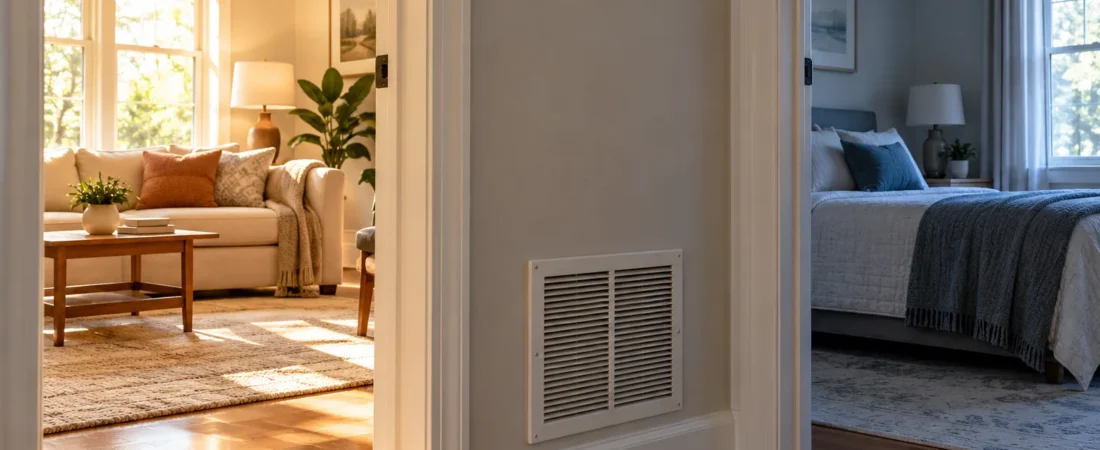
Keep its supply outlet clear of furniture, rugs, and curtains. If the grille has a normal user adjustment, check its position. Look at accessible return grilles elsewhere in the home and keep them clear. Do not close other rooms’ vents to force more air into this one; that changes the system rather than identifying the fault.
A new difference after furniture changes or a blocked grille may respond to restoring clearance. A difference appearing after building work, or persisting with clear outlets, is useful information for an HVAC assessment. Do not enter an unsafe attic or crawlspace to inspect hidden ducts.
If closing the door makes the room warmer
Compare ordinary conditions with the door open and closed while the system and thermostat setting stay the same. A repeatable difference can point toward the room’s air-return path needing evaluation. It does not by itself prove a duct defect. Do not cut the door, add a transfer grille, or alter a fire-rated assembly as a trial fix.
ENERGY STAR’s contractor guidance calls for evaluation of supply/return balance, damaged ducts, leakage, and airflow after repairs. Ask for those measurements when a persistent room difference is attributed to distribution problems.
If the room is hottest in strong sunlight
Note which windows receive direct sun and when the room heats up. Use existing blinds or curtains safely and compare the pattern on another similar day. Keep fabrics away from hot equipment. A response to shading helps identify heat gain as a contributor; it does not establish that the air-conditioning system is correctly sized.
Check normal window and exterior-door closure and visible weatherstripping. For an obvious draft, see the window-draft guide. Rooms above garages, additions, upper floors, and rooms with several exposed walls may need a building-envelope assessment. Avoid adding insulation or sealing ventilation openings without understanding their purpose.
If airflow feels cool but the room stays hot
Room-temperature results matter more than a brief cool sensation at a vent. Record how long the pattern lasts and whether the rest of the home reaches the thermostat setting. If the whole home is warm, use the system-cooling guide. If just one room is affected, discuss distribution and heat gain rather than assuming the main compressor has failed.
ENERGY STAR explains that well-designed, sealed, insulated ducts can improve uneven-room comfort. That is a reason to investigate the system, not a diagnosis of your home or a guarantee that sealing alone resolves the difference.
How to judge a proposed improvement
Give the contractor the temperature log, airflow observations, door comparison, solar pattern, and history of changes. Ask which measurements support the proposed repair and how its result will be checked. A bigger air conditioner or an extra grille should follow assessment rather than guesswork.
After a repair or a simple obstruction/shading correction, compare temperatures under similar conditions. Record whether the improvement lasts and whether other rooms become less comfortable. Persistent unevenness deserves follow-up; repeatedly lowering the central thermostat may cool the comfortable rooms excessively without solving the warm room’s cause.