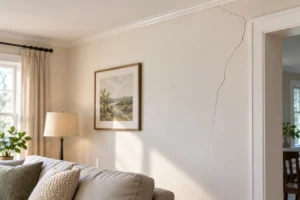
Record a new wall crack before filling it. The material, location, change over time and other building symptoms matter together. A photo cannot confirm structural safety, and neither a fine appearance nor one width measurement is enough to label a crack harmless.
Keep clear of obvious instability
Stay away from a bulging or visibly moving wall, falling material, a sagging ceiling, or damage following a major impact or other event. Obtain urgent local professional or emergency advice where collapse appears possible. Do not push the wall, climb nearby, remove a panel, or open a crack to see behind it.
Cracks accompanied by sudden door/frame movement, new floor distortion, substantial separation or continuing water damage deserve prompt assessment. Do not delay that assessment while collecting a long monitoring record. If you are renting or the wall is shared, report the defect to the responsible property manager.
Describe the material and route
Note whether the visible surface is paint, plaster, plasterboard/drywall, brick, block or another finish. If unknown, say so. Record whether the line follows a joint, extends from an opening, crosses several materials or appears on more than one face. Do not remove finishes to identify the construction.
A crack in a coating is different from a crack through underlying masonry, but a surface observation may not reveal the full depth. Direction and location are useful to a surveyor or engineer; they are not a reliable standalone way to diagnose settlement, subsidence or foundation failure.
What the visible layer can—and cannot—tell you
| Visible location | Useful distinction | Limit of a surface check |
|---|---|---|
| Paint or a thin surface finish | Record whether only the coating appears affected or the line continues into a joint or adjacent material. | Do not scrape to establish depth. A fine-looking line cannot certify the wall behind it. |
| Known plasterboard seam or old patch | Compare the line with the known joint/repair location and previous repair history. | A joint pattern can guide a finish assessment; it does not rule out movement elsewhere. |
| Brick, block, render over masonry, or unknown construction | Report the material as known or unknown, plus changes in openings, floors and adjoining surfaces. | Drywall finishing advice is not a masonry or foundation diagnosis. |
| New or expanding cracks with unexplained sticking doors/windows or changed floors | Arrange assessment of the building and related symptoms together. | Do not treat a decorative filler repair as confirmation of structural stability. |
RICS’s consumer guide identifies expanding cracks, unexplained sticking openings and changed floor levels as reasons to seek specialist help. It concerns UK subsidence and is not a diagnosis of a Saint Lucia building. Local construction, ground conditions and the actual building history require local assessment.
Example of a useful distinction: “A line returned along the same known plasterboard seam after filling” describes a finish-repair history. “A new line crosses an unknown wall and the nearby door has also changed” describes a wider assessment question. These are hypothetical comparisons, not diagnoses or examples of completed repairs.
When arranging the visit, ask whether the assessor will examine only the finish or also the underlying construction and related movement symptoms. This avoids paying for a cosmetic repair when the cause has not been established.
Record change without disturbing the wall
Take a clear photograph from the same safe position, including a ruler beside the crack if that can be done without contact with unstable material. Record the date, location, approximate visible length and any change. Keep the original photos rather than relying on memory or a recently repainted surface.
Include the first time noticed, recent building work, weather or leak events, and whether the same area was previously repaired. If a professional recommends monitoring, ask for the method and review interval appropriate to the building. Do not apply a universal crack-width threshold or decide that an unchanged photo proves the wall is structurally sound.
Separate finish movement from wider building concerns
USG’s drywall guidance explains that temperature, moisture and physical movement can affect gypsum-board joints and finishes. This establishes possible finish-related mechanisms, not the cause of an individual crack or the safety of a masonry wall.
Where the concern is a drywall repair that repeatedly fails at the same seam, use the separate recurring drywall-crack guide. For a new or changing crack with uncertain construction or other movement symptoms, obtain an appropriate building assessment before a decorative repair.
If the crack is stained or damp
Record wetness, staining, peeling or softness without probing the surface. Keep clear if water is near electrics. Use the damp-wall guide to prepare a moisture investigation; repainting or filling while the water source remains active can hide evidence and lead to another failure.
Do not assume that all damp cracks are caused by condensation or that drying alone resolves movement. A professional may need to assess both material damage and the moisture source. Avoid sanding, drilling or scraping unknown older coatings until any hazardous-material concerns are addressed.
Ask what the assessment established
Give the surveyor, engineer or suitable building professional the photographs, timeline, wall material if known, related symptoms and work history. Ask whether the concern is limited to a finish, what cause was established, and whether further investigation or monitoring is required.
If decorative repair is appropriate, have the repair method match the surface and observed cause. Keep the assessment and before/after record. A filled line and fresh paint show that a finish was covered; the evidence of a lasting correction is that the identified cause was addressed and the recommended follow-up completed.