An air conditioner normally starts and stops as cooling demand changes. The concern is repeated premature shutdown and restart, especially when the room remains warm or humid. Before calling it short cycling, distinguish a change in fan speed from the whole system stopping and record what the thermostat is asking the equipment to do.
Stop repeated fault-driven starts
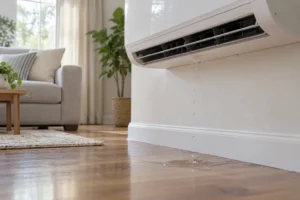
Stop cooling and arrange service if the pattern comes with ice, water leaking indoors, a burning odor, unusual electrical noise, or a repeatedly tripping breaker. Do not repeatedly reset the breaker or rapidly switch the thermostat to force a restart. Keep away from wet or damaged electrical equipment. Do not open panels, test capacitors, bridge controls, or bypass a safety switch.
Use a cycle log that separates fan activity from cooling
Write down events already visible during normal operation, only while there are no stopping conditions described above. Leave an unknown equipment state blank; an outdoor fan turning does not verify compressor operation.
| Field | What to record |
|---|---|
| Time and control | Displayed room temperature, set temperature, mode and any waiting/fault message. |
| Observed change | Airflow stopped, indoor fan continued, or another safely visible change. |
| Start/stop times | Times already observed; no rapid switching or repeated reset tests. |
| Room result | Whether the displayed setting was reached and whether comfort changed. |
| History | New behaviour or present since installation; recent filter/control/service changes. |
Two hypothetical histories: “Airflow changes while the room reaches its setting” does not establish the same fault as “Cooling repeatedly stops with the room still above the setting and a fault message displayed.” The second gives service a control/equipment distinction to investigate. Neither identifies a failed capacitor or refrigerant condition.
Carrier’s linked guide describes several possible short-cycling causes. Use the actual model’s expected control behaviour and the full history instead of declaring a fault from one sound change or applying a universal cycle-duration threshold.
Why total running time can hide a cycling problem
Two systems can appear to run for the same total time while following very different patterns. The following arithmetic example explains why start and stop times belong beside the temperature and fault-message record. These are invented observation sequences, not a normal-cycle standard or measurements from a property.
| Record | Observed sequence | Total activity |
|---|---|---|
| A | One 15-minute active period, followed by 15 minutes inactive. | 15 minutes active; one start within the record. |
| B | Three 5-minute active periods, each followed by 5 minutes inactive. | 15 minutes active; three starts within the record. |
Both records show activity for half the period. That fraction alone loses the number and length of the separate events. It also says nothing about whether the room reached the setting. Report both details rather than saying only “it runs half the time.”
Carrier describes premature shutdown as the concern. Actual acceptable behaviour depends on equipment and conditions. Variable-capacity operation, fan-only activity and compressor operation are not interchangeable. Record only changes already safely observable; do not open equipment or keep restarting it to complete a log.
Record what actually starts and stops
From normal accessible positions, note whether air at the vent stops, whether the indoor fan continues, and whether the outdoor unit appears to stop. A variable-speed system can change sound and airflow during normal operation; the model’s manual helps explain its expected behavior. An outdoor fan’s motion alone does not prove the compressor’s state.
Use the cycle record above to describe a change from the system’s previous behavior. There is no universal “correct” cycle length: weather, load, controls and equipment design differ. A new pattern on an unchanged system remains useful evidence without a precise time threshold.
Separate control behavior from unexplained shutdown
Check the normal thermostat mode, schedule, temporary hold, and any recent app or control changes. If someone keeps changing the setting, observe the system at a steady, reasonable setting instead. Allow the manufacturer’s restart delay; a waiting indicator after a power interruption may be protective behavior rather than a fault.
Note direct sun, a nearby heat source, or cold air reaching the thermostat. Record these conditions without moving the thermostat or disconnecting its wiring. They may make its reading unrepresentative of the room. If the thermostat continues to request cooling while the equipment repeatedly stops, give that distinction to the service provider.
Check permitted airflow maintenance
With the system stopped as the manual directs, inspect a filter intended for user maintenance. Confirm the correct size, type, orientation, and condition, particularly if the cycling began after a replacement. Follow the stated cleaning or replacement method. Keep accessible supply and return openings unobstructed, and do not close many vents to redirect airflow.
If you see ice, do not keep running cooling to test the new filter. Stop and arrange assessment. A blocked filter can contribute to poor airflow, but replacing it is not proof that freezing or shutdown has been resolved. See the cooling guide if the system also fails to deliver cool air.
Why component and sizing guesses can mislead
Carrier’s short-cycling guidance identifies airflow restrictions, thermostat issues, refrigerant problems, oversizing, and electrical components as possible contributors. Similar symptoms can arise for different reasons, so the timing alone cannot tell you which repair is needed. Refrigerant and electrical diagnosis belong with a qualified technician.
Oversizing deserves consideration when poor humidity control and brief operation have existed since installation, but a system that worked normally for years and suddenly changes needs a fault investigation. Do not replace equipment based only on floor area or a guess that “bigger is better.” Ask what measurements and load assessment support a sizing recommendation.
Confirm a stable result or book service
After a permitted control or filter correction, observe at steady settings and similar conditions. Record whether cooling now reaches the desired temperature and whether the unexplained shutdown pattern persists. A single successful start does not establish a lasting fix. If the pattern continues, stop repeated experimentation and arrange HVAC service.
Provide the model, thermostat details, cycle log, onset, filter change history, fault messages, and any ice or leak. For water leakage, mention whether it occurs during operation or after stopping. These details help the technician assess the complete symptom rather than replacing a guessed component.