Identify where and when water appears before taking the faucet apart. A spout that keeps dripping after shutoff, a leak around a handle during use and water below the sink are different symptoms. The correct part and repair depend on the faucet model and leak path, not just whether it has one handle or two.
Contain escaping water and use normal handle pressure
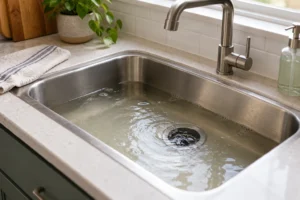
Turn the control to its normal off position without forcing it. Overtightening can damage parts and does not establish why a seal fails. If water is reaching the cabinet, flooring or electrical equipment, stop using the fixture and arrange help. Follow the under-sink leak guide for that separate path.
Use familiar accessible isolation valves only if they work gently and safely. A valve that is seized, leaks when moved or fails to stop the supply needs a plumber. Never loosen faucet parts while the supply remains live. Touchless or powered models also have their own isolation and service requirements.
Shutoff leakage and water around the base are different paths
| Water appears | Relevant distinction |
|---|---|
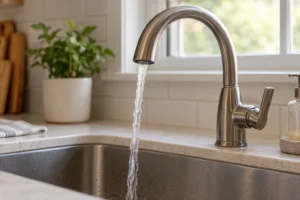
| At the spout after normal shutoff. | Distinguish a few residual drops that stop from continued leakage through the shutoff path. |
| Around a handle or spout base during use. | Trace the first renewed wet area on an accessible sound surface; water can travel from the handle to the base. |
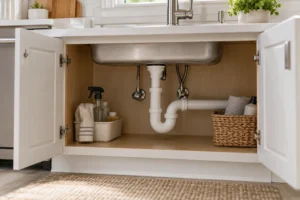
| Below the counter or along a spray hose. | Use the under-sink guide; a spout cartridge is not automatically the relevant part. |
Moen’s base-leak guidance warns that a handle leak can collect around the base plate and resemble a base leak. It also distinguishes conventional spouts from pull-out/pull-down arrangements. This is why the puddle location alone is insufficient to order a seal.
For the cartridge-equipped Moen example below, the cartridge controls water flow. A moving spout joint and a hose connection perform different functions. These examples explain the distinction; they are not a universal disassembly sequence for every faucet.
If the spout drips after the faucet is off
Record whether a few residual drops cease or a drip continues between uses. A continuing leak needs investigation of the model’s shutoff components. On a two-handle faucet, note any existing temperature pattern, but do not touch unexpectedly hot water or assume a lukewarm drip identifies one side reliably.
Find the brand, model and parts diagram. Moen’s kitchen-faucet example explains that its cartridges control water flow and that different cartridges are not interchangeable. A continuous spout leak with the handle off makes the shutoff path relevant, but it does not identify a universal replacement part. Confirm the exact compatible component and repair instructions.
If water appears around a handle or the spout base
Observe from a safe position whether water appears only while the faucet runs, during spout movement or even when it is off. Wipe an accessible sound surface dry where safe and note the first renewed wet area during brief ordinary use. Stop if water escapes into the cabinet; do not keep running it to obtain a better photograph.
Report that location to the manufacturer or plumber. A base seal, moving spout joint and valve leak can need different work. Do not caulk the base to trap escaping water or tighten every visible nut indiscriminately. Concealing the route can make the real leak harder to find.
If a pull-out hose or spray connection leaks
Note whether the leak follows hose movement or appears at a visible connection. Keep stored items clear of the moving hose without pulling on connections. Do not operate the faucet if the hose is damaged or leaking below the counter.
Quick-connect fittings, threaded spray heads and older hose arrangements have different attachment methods. Use the exact product instructions for any suitable owner maintenance. Do not put thread tape, glue or sealant on a connector unless the manufacturer specifies it; those additions cannot make an incompatible or damaged fitting sound.
If the drip began after a repair
Keep the fitted part number, invoice and date. Tell the installer whether the problem is unchanged or moved to a different location. Incorrect fit, installation, debris and other damage need different checks; the timing alone does not establish the cause.
Ask the installer to verify the repair against the model’s diagram and instructions, including any seals or retainers disturbed. Do not adjust household supply pressure merely because a new cartridge still drips. If pressure is suspected, it should be assessed appropriately rather than guessed.
Decide whether this is a suitable owner repair
A minor repair may be practical when the exact model, compatible parts, safe isolation and manufacturer procedure are understood. Read the complete instructions before disassembly and confirm what tools and reassembly checks are required. A concealed wall valve, corroded fitting, inaccessible supply or unfamiliar powered control expands the scope.
Use professional help where those conditions are uncertain. Avoid removing a stuck cartridge by improvised force or substituting a seal because it seems close in size. Preserve removed parts and photographs for identification if a repair cannot be completed.
Check more than the original drip
After safe reassembly, follow the manufacturer’s restoration procedure and inspect all disturbed connections during normal use and after shutoff. Verify handle operation, flow and temperature control as well as the drip. Stop if a new leak appears.
Keep the part and work record. If leakage returns, describe the precise location and timing again. That helps distinguish failure of the same shutoff path from another leak instead of repeating a cartridge replacement that does not address the symptom.