
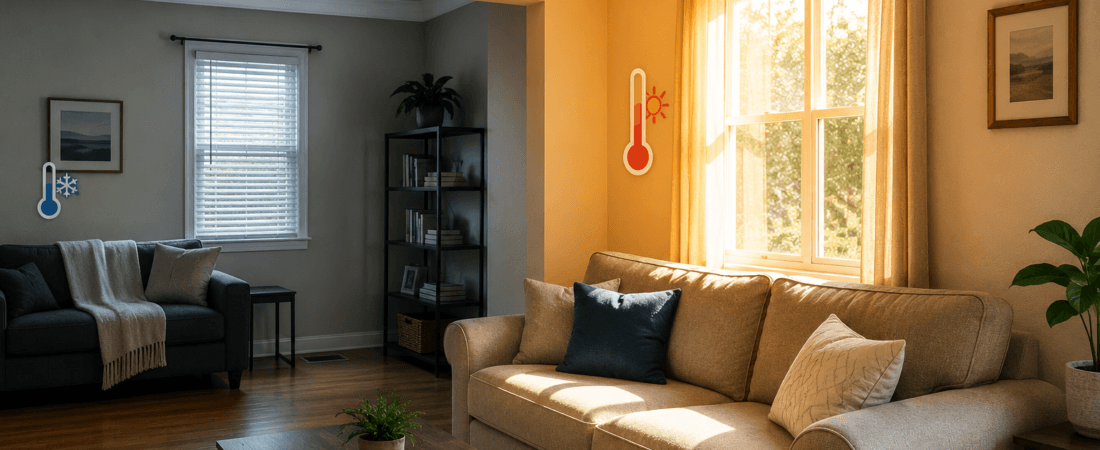
If most of your home feels comfortable but one room remains noticeably warmer, the air conditioner itself may not necessarily be the problem.
Airflow, sunlight, insulation, room location, and several other factors can create temperature differences throughout a home.
1. Check the Vent
Make sure the supply vent in the warmer room is fully open.
Check that furniture, curtains, boxes, or other objects are not blocking airflow.
Compare the amount of air coming from that vent with vents in nearby rooms.
2. Check the Return Airflow
Air needs to circulate back through the HVAC system as well as enter the room.
Avoid blocking return-air grilles with furniture or other objects.
Rooms with poor circulation may remain warmer even when cool air is being supplied.
3. Consider Sunlight
Rooms receiving strong afternoon sunlight can become significantly warmer than other parts of a home.
Closing blinds or curtains during the hottest part of the day may reduce some of the heat entering through windows.
4. Check Doors and Windows
Warm outdoor air entering around poorly sealed doors or windows can make a room harder to cool.
Look for obvious gaps or damaged weatherstripping.
5. Consider the Room’s Location
Upper-floor rooms, rooms above garages, additions, and spaces with several exterior walls may experience different temperatures from the rest of the home.
Insulation and building design can significantly affect how quickly these rooms gain heat.
6. The HVAC System May Need Balancing
If some rooms consistently receive much more conditioned air than others, the system’s airflow distribution may need professional evaluation.
Duct problems can also reduce airflow to particular areas.
When Should You Call an HVAC Professional?
Consider professional help if:
- One room remains significantly warmer
- Airflow from its vent is very weak
- Several rooms have uneven temperatures
- The problem recently developed
- You suspect damaged or disconnected ductwork
- The AC runs excessively trying to cool the home
Temperature differences can sometimes be improved with simple airflow adjustments, but persistent differences may indicate an HVAC or insulation issue.