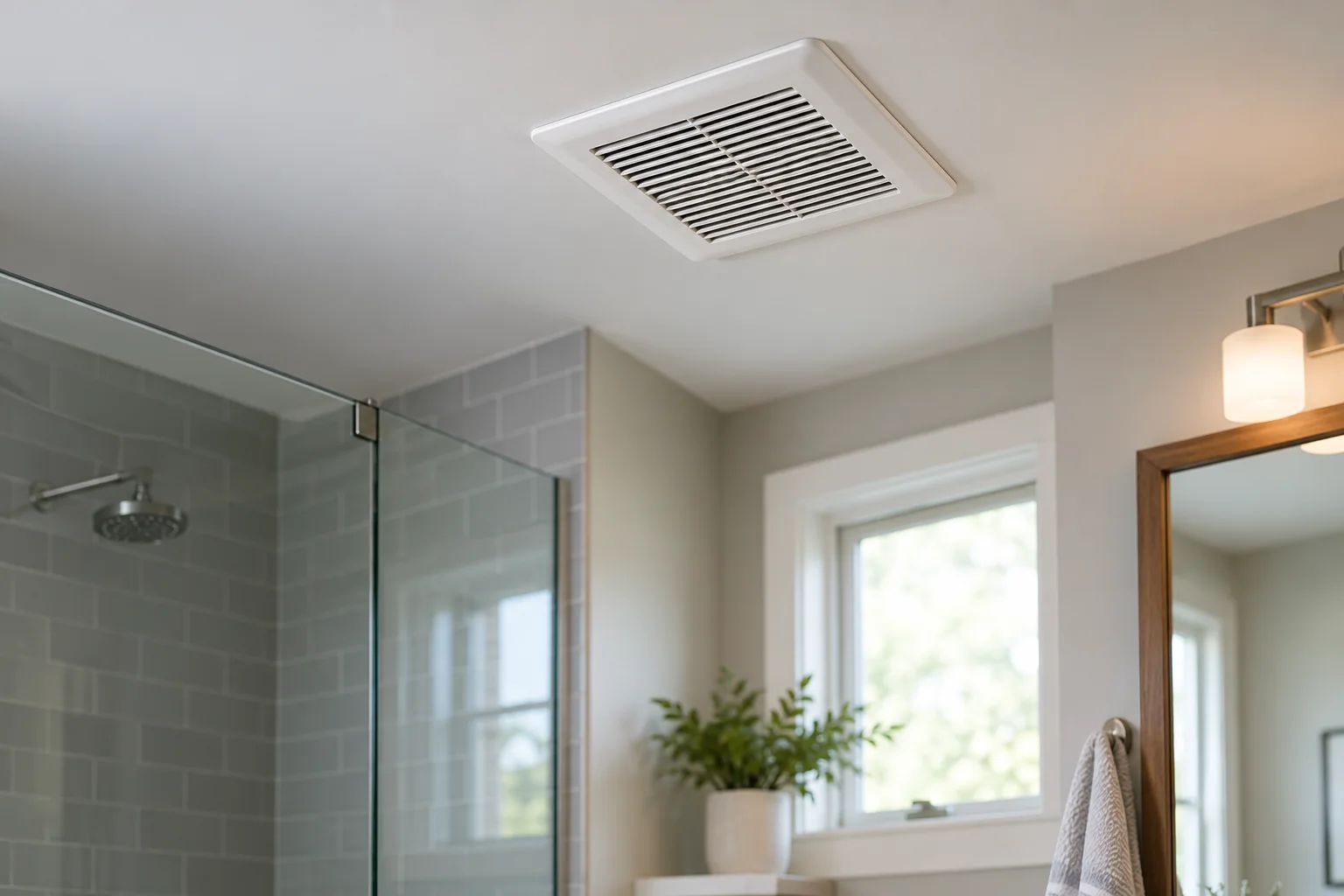
Describe whether the fan is silent, hums without normal operation, makes new mechanical noise, or runs while moisture persists. A working light does not prove the fan works, and a spinning fan does not establish that moist air reaches outdoors. Identify the model and normal control behavior before assuming a replacement motor is needed.
Stop for electrical, mechanical or water warning signs
Switch off using the normal control if the fan hums abnormally, grinds, smells of burning, sparks or repeatedly trips a breaker. Keep away from a wet grille, nearby wet wiring or a sagging ceiling. Do not reach into the unit, push the impeller or repeatedly restart it to reproduce the fault.
Do not remove wiring covers, bypass controls, spray lubricant into a motor, or reset a recurring electrical fault. If safe isolation is uncertain or moisture is reaching electrics, obtain appropriate professional help. Use the breaker-trip guide to describe the history rather than testing by repeated resets.
If the fan does not appear to start
Consult the exact model’s operating guide for its switch, timer, sensor and separate light/fan controls. A humidity or occupancy setting may differ from a simple on/off switch. Check only the ordinary user controls and record displayed indicators; do not open a wall switch or change concealed connections.
Note whether it stopped after a power interruption, cleaning or service, and whether other fixtures were also affected. If normal controls do not restore expected operation, give those details to an electrician or suitable fan technician. A working bathroom light is not a diagnosis of the fan’s supply or motor.
If it runs but the room stays damp
Record the shower pattern, control setting, approximate operation period and how moisture clears compared with previous ordinary use. Check that required replacement-air paths are not blocked, without cutting a door or altering a designed ventilation arrangement. Avoid assuming that an open door alone proves the duct is sound.
Broan-NuTone’s moisture-removal guidance identifies replacement air and duct resistance as factors that can limit performance. These are installation questions as well as fan questions. A larger replacement fan may still perform poorly through an unsuitable duct or outlet.
Use the manufacturer’s operating advice and appropriate ventilation design guidance for runtime. There is no single duration that verifies every bathroom has dried. Do not deliberately generate extra steam or hold paper against a running grille as a substitute for a proper airflow assessment.
Clean only the permitted accessible parts
Where the manual allows owner grille cleaning, isolate the unit as directed, let it stop and cool, and use safe access. Do not stand on a wet bath edge or an unstable object. Remove only parts the owner instructions permit, and keep hands clear of the fan and electrical components.
The Broan-NuTone Upgrade/Replacement 80 CFM, 2.5 Sones Motor Kit guide (S97015162) specifies cleaning methods and states that its motor is permanently lubricated. That guide applies to its listed compatible models; it is not a cleaning or dismantling procedure for every bathroom fan. This illustrates why spraying oil is not a general fan remedy; use the actual model’s instructions rather than copying another unit’s disassembly.
Do not use water, solvent or cleaner near a sensor or motor unless the precise instructions permit that use. If the grille cannot be safely accessed or the fault is beyond routine cleaning, leave it for service. A clean grille does not prove the concealed duct is clear.
What the fan rating does—and does not—measure
A replacement quote may list airflow, sound and electrical ratings together. They answer different questions. Keep the exact model and test conditions with the numbers rather than choosing the largest or loudest fan as the presumed solution.
| Label | What it describes | What remains to establish |
|---|---|---|
| CFM (cubic feet per minute) | A volume airflow rate under the stated rating conditions. | The airflow delivered by this installed fan through its actual duct and outlet. |
| Sones | A sound rating. | Whether useful extraction occurs; audible operation is not an airflow measurement. |
| Static pressure on a performance specification | A resistance condition associated with the airflow rating. | Whether the rating being compared represents the installed duct conditions. |
For example, Broan’s Model 695 specification states airflow together with a static-pressure condition and a separate sound value. It is a product example, not a recommendation for your room.
Ask the installer to identify the existing air path and, where performance is in doubt, assess installed airflow before proposing a replacement. A quieter fan can be effective; a noisy fan can still have a poor air path. Neither sound nor a catalogue CFM figure establishes how quickly wet surfaces will dry.
Have the duct route and outlet checked when indicated
Ask the installer to establish that the unit exhausts outdoors through an appropriate connected route, rather than into a roof space or wall cavity. Restrictions, disconnection, unsuitable fittings, a blocked outlet or condensation can require different corrections. Do not climb into an unsafe loft or onto a roof to investigate.
If water drips from the fan or wetness appears during rain, record the timing and stop using it where water/electrical concerns exist. Ask for assessment of both water entry/condensation and ventilation performance; extending the runtime is not a general repair for a wet electrical unit.
Verify moisture removal after repair
Ask what fault was found and how the normal controls, airflow and duct/outlet arrangement were checked. Compare the bathroom through ordinary use afterward. Record whether moisture persists or returns even though the fan sounds normal.
If recurring growth remains, use the bathroom mold guide to consider leaks and material condition alongside extraction. A repaired fan does not automatically resolve a separate moisture source or damaged wall.