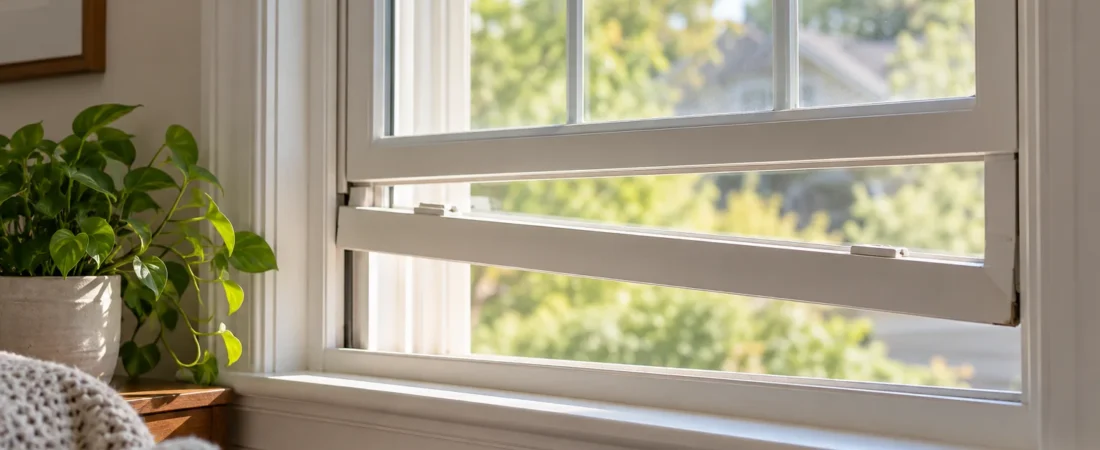
A falling or unstable window is a support problem before it is a convenience problem. Stop operating it repeatedly. Identify whether a sliding sash drops, one side becomes crooked, or an outward-opening window drifts closed, and give that pattern to a repairer with the window’s model. Different window types use different hardware.
Keep people away from an unstable sash
Keep fingers, children and pets out of the opening. Do not rely on a stick, book or other loose object to support the glass, and do not use the screen as support or fall protection. Do not release the sash again to prove that it falls. If it cannot be left safely closed using ordinary controls, keep the area clear and arrange urgent appropriate help.
Do not remove hinge screws, sash stops, tilt pivots or balance components. The sash can be heavy, and support parts can be under tension. Damaged glass, loose framing, or an upper-floor opening requires suitable professional handling. If the fault affects an escape window, arrange prompt repair rather than fixing it shut.
Identify the window type and change in behavior
Record whether it moves vertically, slides horizontally, or swings outward on hinges. Find the maker and model from accessible labels or installation paperwork without taking the sash out. Note whether the problem started after cleaning, tilting, painting, installation, or a long period of normal use.
For a vertical sash, report which sash is affected and whether both sides move evenly. For a hinged window, report the operator, hinge or stay behavior already observed. Do not assume that every window has a cord-and-weight system or that every opening angle is intended to remain unsupported.
Vertical sash and hinged windows use different hardware
| Window movement | Useful model-specific information |
|---|---|
| Vertical sliding sash drops or becomes crooked. | Which sash and side are affected; whether it began after normal tilt-cleaning; exact series if known. |
| Outward-opening casement or awning window changes position. | The operator/handle/stay arrangement and intended operating positions from that window’s guide. |
| Movement type or manufacturer is unknown. | Use accessible labels, invoices or a safely taken photograph; do not remove support parts to identify them. |
Andersen’s casement/awning explanation distinguishes the operator, handle and cover, and notes different operator styles. Those are not the same system as a double-hung sash balancer. This comparison is for identifying the service question; it gives no adjustment, spring-release or sash-removal procedure.
If it began after tilting a double-hung window for cleaning
Andersen’s 400 Series tilt-wash guidance explains that balancers in the frame hold the sash in place. Its written instructions identify the series and hardware version; they are not a universal balance-reset procedure. A change after tilting should be assessed using the exact window instructions rather than a generic re-engagement method.
If normal cleaning left the sash crooked or unsupported, stop and consult the exact owner instructions or the manufacturer’s service provider. Do not improvise re-engagement from a video for another model, force the sash back into the frame, or work while holding the glass with one hand. Report the cleaning step after which operation changed.
If a previously stable vertical sash now drops
A support mechanism may need repair, but dirt in a track and a failing balance are different findings. Photograph visible damage from a safe position. Do not raise an unstable sash simply to clean below it or assume that lubricating the track will restore its support.
Andersen’s replacement guidance requires identifying the window series and following the matching written instructions; it also notes hardware revisions. This illustrates why choosing a balance by appearance alone or following an older video can be misleading. Have the repairer identify the proper components and support method.
If an outward-opening window drifts closed
Consult the window’s operating guide for its intended control, stay and permitted opening positions. Wind and the design of the operator matter. Do not tighten an unknown screw, disconnect an arm, or prop an outward sash against its glass. A damaged hinge or stay needs assessment without leaning outside.
If closure, locking or sealing has also deteriorated, include those symptoms. Use the window draft guide after stable operation is restored; adding a seal is not a repair for unsupported glass.
Verify safe operation after the correction
Ask the repairer what caused the loss of support, which model-specific component or engagement was corrected, and whether the glass, frame, operator and safety devices remain sound. Confirm intended opening, holding, closing and locking through normal use without a makeshift prop.
A failed balance or stay does not by itself prove the complete window needs replacement. If replacement is recommended, ask which additional defects prevent a suitable repair. Record recurring stiffness, uneven movement or renewed dropping and stop operation if safe support is lost again.