Identify the point at which closing fails: the door meets an obstruction, rubs the frame, reaches the frame but will not latch, or latches while the deadbolt still binds. These are different symptoms. Stop forcing the door and note which one occurs before adjusting hardware or cutting material.
Keep the door safe to use
Arrange prompt help if an exterior door cannot secure normally or an exit cannot open reliably. Do not wedge shut, screw shut, or disable a lock on an escape route to make the door seem repaired. A heavy, glazed, loose, or damaged door needs appropriate support and professional handling; do not remove hinge pins to investigate.
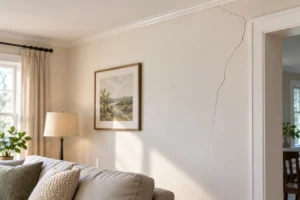
Do not modify a fire door, closer, latch or certified seal using general household advice. In a rented property or shared building, report the defect to the responsible manager. If several doors suddenly shift, a frame separates, or new wall movement accompanies the change, seek assessment of the wider problem before treating each latch independently.
If an ordinary obstruction prevents closing
With the door supported normally and fingers clear of the hinge and latch edges, look for a rug, loose object, displaced removable item, or hardware interfering with the path. Remove only an obvious ordinary obstruction. Do not cut off weatherstripping or pull a fitted seal away because it resists closure.
Note whether the issue began after new flooring, painting, a seal replacement, or hardware installation. The installer may need to correct the fit. Repeated slamming can damage the latch and frame without resolving what changed.
If the edge rubs before it reaches the frame
Look for scrape marks and uneven gaps without levering the door. Describe the contact location: upper latch corner, hinge edge, floor, or full-length edge. Swelling, sagging, and frame movement can create similar resistance but require different corrections.
Use the separate sticking-door guide for a rubbing problem. Do not plane or sand a door before the cause and door construction are established. Removing material can damage seals, veneers, clearances or the door’s rated performance. Visible hinge movement is useful to report, but it is not permission to replace screws with arbitrary longer ones.
If it reaches the frame but does not latch
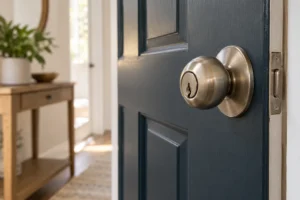
Observe whether the latch lines up with the strike opening and whether the handle returns normally. Keep fingers away from the moving latch. A latch hitting above, below or beside the opening suggests a fit issue; a latch that does not retract or spring back can involve the hardware itself. Do not force either to prove which part failed.
Schlage’s door-latching guidance discusses alignment between the door, latch and strike. Use the instructions for the exact door and lock before an adjustment. Filing an opening or moving a strike plate can conceal sagging or reduce secure engagement if done without assessing the complete fit.
A new seal can also affect how far the door closes. Ask the installer to verify the specified seal and normal latch engagement rather than removing it. A door should not need an unusually hard push or sustained pressure to remain latched.
If the latch works but the deadbolt binds
This is a lock-operation issue as well as a closing issue. Record whether the door must be lifted, pushed or pulled before the key turns. Avoid forcing the key or using the bolt to draw a misaligned door into position. Use the stiff-lock guide to prepare the locksmith’s assessment.
Do not conclude that a door is securely locked merely because a key turns partway. A locksmith or door installer should confirm full normal engagement and reliable unlocking from the appropriate sides without compromising an escape route.
Check the correction through ordinary use
Give the repairer the symptom category, contact marks, gap pattern, timing and recent work. Ask whether the correction involved the door fit, frame, hinges, seal, latch or strike, and whether a wider movement problem was ruled out when indicated.
After repair, check ordinary closing, latching, locking and opening without slamming, lifting the slab, or holding it under pressure. Confirm that fitted safety hardware still functions. If the problem returns with weather or humidity, record that timing for a follow-up instead of repeatedly enlarging the strike opening.